Resources
There will be links here to various documents outlining the map generation.
Richard Middleton [info@natstand.org.uk] last updated 14 June 2024
There will be links here to various documents outlining the map generation.
There has been a belated recognition of the value of maintaining biodiversity and there is a strong movement towards the restoration of degraded habitats and the creation of new areas for wildlife. The urgent necessity for solar/wind/nuclear energy will require large and rapid changes to land use and, in view of their statutory environmental obligations, developers will be looking towards implementing various mitigation plans. Clearly things like the ubiquitous “tree-planting” will be high on the agenda but where will (or should) they put them? Looking at current tree-planting initiatives they do not always seem to be focused in the best areas for the successful establishment of diverse woodland eco-systems. It seems that favoured sites are currently those with little tree-cover (despite the fact that they may have been treeless for millennia.) Perhaps some areas would benefit from creation of different habitat types? So far as I am aware there are no simple maps of the region showing the best areas for the improvement/establishing of particular habitats. Habitats will be easier to create, or will improve more rapidly and sustainably, in areas that are now, or are known to have been suitable in the past, as some of the important invertebrates, fungi, bacteria, etc. may still be present. There may also still be a viable seed bank. Although some plants occur almost ubiquitously over a large region, many, because of their physiological requirements, are restricted to a particular broad habitat. It should therefore be possible to use the distribution of these species to determine the extent and location of these habitats – the more of these taxa that are recorded in a particular place the greater the confidence of the habitat type. When evaluating the potential of a site for habitat restoration it would be reasonable to regard historical records of these indicator species as indicators of suitability. This is a consideration which cannot be made based on a site survey alone.
This website is an attempt to facilitate the use of historical distribution data along with modern records to identify the parts of the vice-county which are the most suitable for the successful establishment of various habitats. At the heart of the process is the nomination of the plant species which should be used to characterise the habitat types. To make the process unbiased, four experienced local botanists have provided lists of the plants that they consider worthy components of local woodland, calcareous grassland, neutral grassland, wetland and heath in the vice-county. Although the lists differed in detail, there was a good consensus and the final habitat lists were made using taxa which received nomination by three or more of the respondents. I am greatly indebted to Peter Cook, Gabrielle Jarvis and Rohan Lewis for their contributions, together we can claim over a century of practical experience of the region’s flora.
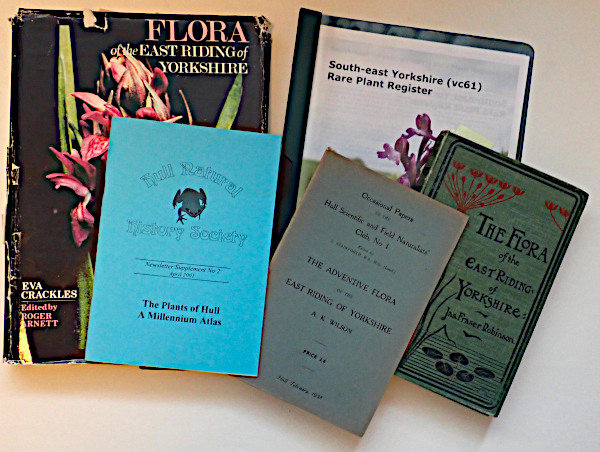
The core distribution data set was constructed at tetrad resolution from the 465 maps presented in Crackles’ 1990 Flora of the East Riding of Yorkshire and a download from the BSBI database with additions up to 2019. In all this generated distribution data for over 1200 taxa. It became apparent that, although recording coverage was good in some parts of the region, it was not complete at the tetrad level. Experimentation demonstrated that, for the best results, each tetrad record should be expanded into 20 surrounding monads. (Examples of the process are included in the presented mapset.) Thus, each tetrad record generated data for 24 monads. Habitat suitability maps were generated by examining each of the 3242 monads in the vice-county and counting the number of target species recorded there. The viewer on the map page may be used to display the maps produced by this process.