
Major Edward Topham (1751 - 1820)
a Yorkshire neighbour
Thornton > Topham
series 2
Major Edward Topham (1751 - 1820)
a Yorkshire neighbour
Thornton > Topham
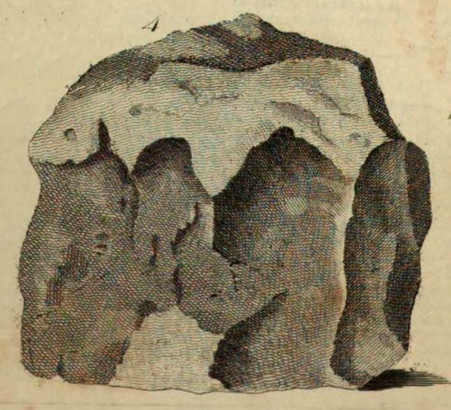
The Wold Newton meteorite from an engraving in The Gentleman's Magazine, 1796.
Major Edward Topham was a close neighbour of Thomas Thornton and a frequent participant in his Yorkshire hunting parties. Like the Colonel, Edward was the eldest surviving son of a wealthy family with its roots in the York area. Both men were university-educated although neither of them actually graduated with a degree. Likewise both followed early military careers with Topham perhaps seeing a little more action than Thornton. Whereas Thornton devoted the rest of his life to sporting pursuits, Topham was of a more intellectual disposition and spent many years in London as a playright and editor of "the World", before retiring to Wold Cottage, Thwing, as a gentleman farmer in the 1790s.
Like Thompson, Edward Topham's domestic arrangements were somewhat unorthodox. He does not appear to have ever married, but raised three daughters born of a relationship the celebrated, but excentric, actress "Mrs Wells." The couple had separated before his arrival at Wold Cottage with his daughters; all of who made respectable marriages.
Although celebrated in his time as an author, his main claim to Natstand notice is his association with the Wold Cottage meteorite of 1795. This fell within a short distance of his house and, although not in residence, on his return he had the presence of mind to collect sworn statements from those who saw or heard its descent. It remains the heaviest meteorite to have been observed to fall in Britain and his recognition of its significance and actions to bring it to the attention of science were instrumental in the acknowledgement of their extra-terrestrial origins.

| The fall 1795 December 13 Sunday, 3 p.m. |
¹December 26, Hull Advertiser
"Sunday the 13th instant at three in the afternoon, the inhabitants of Woldnewton, in the county of York, and the villages adjoining for eight miles round, were very much terrified by a strange Phaenomenon; a report was first heard resembling the discharge of two large cannons, one following the other about the space of half a minute, and immediately after rumbling noise, its direction seemed from east to west; at the same instant a stone fell out of the air weighing 55lbs, two hundred yards from Wold Cottage near Woldnewton, the residence of Captain Topham, and not more than thirty yards from three of his servants, who were amusing themselves in the field at the same time, by the velocity its fall it penetrated the ground eighteen inches; it was warm when it fell, the outside very black, and smelled strong of sulphur immediately followed a very heavy shower of rain: there are many neighbouring gentlemen have been to see it, who probably by this time may have discovered the reason of so unusual a thing; some people suppose it has been done by art, but most thinks it to be a Phaenomenon, it is of the nature of the freestone, and has shining particles when broken, it rings when struck like a limestone, and is not any way different in weight or size to our common freestone. " This appears to be among the first official announcements of the fall. Major Topham was in London at the time of the event and the delay may indicate that he returned to Wold Cottage for Christmas. |
|
| 1796 Public Exhibition, London |
This public exhibition brought the meteorite to the attention of the London scientific establishment. Contemporary scientific opinion on the origin of such "falling stones" was divided and there was a popular belief that they may have been condensed from the atmosphere by lightning (thunderbolts). Although Edward Topham did not observe the fall, he was a well educated and literate man who would well understand the importance of the event. On his return to Wold Cottage he had taken great care to collect sworn statements from all those who had witnessed or heard the fall. Copies of these statements were provided to those attending the exhibition, along with an engraving of the object. It may be that it was this exhibition which caught the attention of Sir Joseph Banks, the President of the Royal Society, who is known to have acquired a sample of the stone. |
|
| 1797 July Publication of the full details |
The Gentleman's Magazine:
This article is based on a letter from Edward Topham to James Boaden on 1796 February 8, which had been printed in "The Oracle" soon after. It also reprints the witness testimonials distributed with the Piccadilly exhibition the previous year, along with an illustration. This article assembles all of the contemporary accounts of the fall. A link to a transcription is provided on the right. |
 |
| 1802 February 25 Chemical analysis |
Philosophical Transactions of the Royal Society. Experiments and observations on certain stony and metallic substances, which at different times are said to have fallen on the earth; also on various kinds of native iron. By Edward Howard, Esq. F.R.S. Read February 25, 1802.
This paper is the first scientific investigation of the chemistry of meteorites. There was still controversy over the origin of such objects and great scepticism of their extra-terrestrial origin. There was even a belief among some scientists that they were condensations from the atmosphere, and an association with lightning was widespread. This is alluded to in the description of the circumstances surrounding the fall of the Yorkshire stone where stress is placed on the fact that "… there was not any thunder or lightning the whole day." The paper shows that, after its exhibition, a specimen taken from Topham's stone was acquired by the President of the Royal Society … But the Right Hon President of the Royal Society [Sir Joseph Banks], ever alive to the interest and promotion of science, observing the stone so exhibited to resemble a stone sent to him as one of those fallen at Sienna, could not be misled by prejudice: he obtained a piece of this extraordinary mass, and collected many references to descriptions of similar phenomena. The final paragraph is interesting - From these facts, I shall draw no conclusion, but submit the following queries |
 |
| 1804: James Sowerby acquires the meteorite | ¹York Herald: 1804 July 21
Mr. SOWERBY, under the inspection of Sir JOSEPH BANKS, is now taking very accurate and beautiful drawings in his Mineralogy, of the different Sky-fallen Stones that have appeared in different countries. He has already taken a very accurate resemblance of that of Monsieur Langle, and he is about to take a drawing of that of Major TOPHAM's which fell at Wold Cottage, in this county, as being the most singular in the History of Natural Curiosities. It is generally accepted that James Sowerby purchased the Wold Cottage meteorite from Edward Topham for 10 guineas around this time. |
|
| 1805 December 7 | ¹Morning Chronicle
The phenomenon of the meteoric stones, said to have fallen some time ago in Normandy, induced us to examine the accounts of similar phenomena which have occurred in this country. Of these there are several instances. But the largest meteoric stone that has ever been known to fall in, England is now in the possession of Mr. Sowerby, at Lambeth. It fell, on 13th December 1795, near Wold Cottage, Yorkshire. It Weighs 56lb. and is, perhaps, the finest specimen of meteoric stone in the world. Indeed Mr. Sowerby's Collection of Animals, Vegetables, and Minerals, is now so very extensive, and has been made with so much labour, and at so great an expence, that it is to be wished, both for his own benefit and for the benefit of the student of Natural History, that he could be prevailed upon to open his Museum for the inspection of the Public. If a Course of lectures, to be delivered in his Museum, were to be instituted at the same time, illustrative of the different subjects, and introductory to the study of, Natural History in general, we think it might be productive, at least as far as it goes, of a utility equal even to that of our more splendid and expensive institutions. James Sowerby was a noted botanist and scientist, the specimen was to feature in his "Mineralogy." | |
| 1831 May 11 Sale of Sowerby's collection |
¹London Courier and Evening Gazette
THE late Mt. JAMES SOWERBY'S MUSEUM, at No.2, Mead-place, Westminster Road, near the Asylum (no part of the property of Mr. G. B, Sowerby, of Regent-street) has been on sale for the purpose of settling some legacies, now due, only since the 18th of April. The Geological Collection having been sold entire there now remain the Collections of British Shells, Crustacea, Insects, and Birds. The fine Collection of English minerals was opened on the 2d of this month, and will continue on sale, in separate Specimens, daily. The magnificent Yorkshire Meteorite is offered for 350l. [£350] |
|
| 1838 February 23 | ¹Hull Packet
The celebrated Yorkshire Meteorite, in the posession of the family of the late Mr. Sowerby, is proposed to be sold, as soon as £300 are subscribed for it, with a view to its being preserved in the British Museum. It is certainly a very important object in national science. It clearly had not been sold at the earlier sale and was being discounted. This does not tie in well with the general belief that the British Museum bought it in 1837 for £250. |
|
| 1866 November 3 Weight loss ... |
¹Lancaster Gazette
AEROLITES … The largest and most notable of all these [aerolitic rocks] fell on December 13, 1795, near Wold Cottage, in the parish of Thwing, East Riding of Yorkshire. Its descent was witnessed by two persons; and when the stone was dug up, it was found to have penetrated through no less than 18 inches of soil and hard chalk. It originally weighed about 56lb, but the portion of it preserved in the British Museum is stated in the official catalogue to weigh 47lb 9oz. 56 grains … |
|
| 1880 Scientific report |
Hall, T. M., 1880. Contributions towards a history of British meteorites. Mineralogical Magazine No. 13, Vol III, 1 - 17.
1795. - December 1. - 3 Wold Cottage, Thwing, East Riding of Yorkshire. This celebrated meteorite fell on a Sunday, at 3 o clock in the afternoon, in the grounds of Major Topham. It penetrated into nineteen inches of soil and hard chalk and weighed 56 lbs. The stone was transferred by Major Topham to Mr Sowerby, and was subsequently purchased by the British Museum for &spound;250.{Sowerby's Mineralogy, p.222.} According to the official catalogue the present weight is 47 lbs 9 ozs 53 grains. {The latest catalogue gives the weight as 45 lbs. 8 ozs.} The Imperial cabinet at Vienna also possesses a small specimen. The specific gravity as given in Rep. Brit. Assoc., 1860, p. 61, is 3.70. In 1796 the stone was exhibited in London, and in the same year an account of the fall was published in the Gentleman's Magazine. The chemical composition was investigated by ²Luke Howard, and compared with that of Meteorites from Portugal, Sienna, and Benares. The results were published in the Philosophical Transactions for 1802, under the title of "Experiments and Observations on certain Stony Substances, which at different times, are said to have fallen on the Earth." According to Phipson {Meteors, aerolites, and falling stars, p. 5.} this paper is remarkable as containing the first chemical analysis of an aërolite that was ever made. ²The original Royal Society paper was by Edward Charles Howard FRS (1774 - 1816) not Luke Howard FRS (1772 - 1864). |
1 Transcription reproduced with kind permission of The British Newspaper Archive